
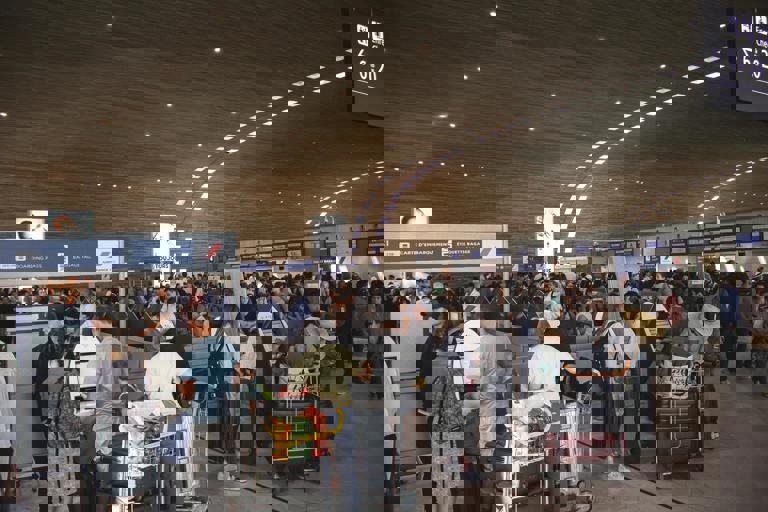
A startling discovery at the city’s main airport has put airport security procedures under the spotlight after a couple was detained having nearly $500,000 hidden in their personal luggage. The incident unfolded on a busy weekday when routine checks led security officers to become suspicious of two travelers at the international terminal. Their bags, which seemed innocuous at first glance, contained cleverly concealed bundles of cash wrapped in various layers of clothing and everyday items.
According to authorities, the money was uncovered during an otherwise standard inspection using X-ray technology, which picked up irregularities in the density of items inside the luggage. The flagged suitcases were then subjected to a more thorough manual search, eventually revealing the carefully hidden cash. Airport security officials noted that the method of concealment appeared sophisticated, requiring significant effort to both hide and retrieve the funds without arousing suspicion.
The detained couple, whose identities have not yet been officially released pending further investigation, were reportedly traveling on valid passports. Their itinerary included several international destinations, which has now drawn the attention of both national law enforcement agencies and border security. Law enforcement sources have stated that the volume of money involved suggests a potentially organized operation rather than a personal attempt at currency smuggling.
Peter Lavallee, a spokesperson for the Canada Border Services Agency (CBSA), commented on the gravity of the situation: "We take discovered attempts to move large sums of undeclared cash across our borders extremely seriously. Such activities often have links to money laundering and organized crime." He emphasized that the CBSA routinely collaborates with other federal agencies to determine the origins and intended uses of such seized funds.
Under Canadian law, any traveler entering or leaving the country is required to declare if they are carrying $10,000 or more in cash or monetary instruments. Failure to declare amounts above this threshold can result in the seizure of the funds, criminal charges, and further investigative action. Airport security measures regarding cash declarations have been heightened in recent years in response to increasing concerns about financial crime and terror funding.
This incident has reignited debate about the adequacy of airport screening processes and the effectiveness of existing anti-money laundering frameworks. Security expert Alison Weiss told reporters, "Recent events show just how creative individuals have become in trying to circumvent detection. Technology is improving, but ongoing training and investment are critical to stay a step ahead." She also highlighted the importance of inter-agency cooperation in tackling cross-border financial crime.
Travelers at the airport expressed a mix of unease and relief upon learning about the incident. One passenger, Maria Chen, said, "It’s amazing how much goes on behind the scenes. I travel frequently, and I’m glad the security checks are thorough—even if it means waiting longer during busy periods." The airport authority has reassured the public that passenger safety remains their top priority, and additional vigilance will be maintained.
In financial crime circles, this case is notable for the sheer sum intercepted, as large undeclared cash movements are a red flag for anti-money laundering units. According to 2022 statistics from FINTRAC, Canada’s financial intelligence unit, airport seizures of undeclared cash have been rising, with over $15 million intercepted nationwide last year alone. Financial experts warn that figures like these may represent only a fraction of actual illicit flows.
The detained couple is currently cooperating with law enforcement and has retained legal counsel. A court hearing is scheduled for later this week, where officials will determine whether formal charges will be filed. Legal analysts say penalties could range from significant fines to potential imprisonment, especially if the investigation uncovers evidence of criminal conspiracy, intent to launder money, or links to other illicit activities.
Several questions remain unanswered: who the intended recipient of the funds was, the source of the cash, and whether the couple acted alone or as couriers for a larger network. Authorities have indicated that forensic analysis on the cash and ongoing interviews may shed light on the broader context. The case has also prompted an internal review of protocol to identify vulnerabilities in current screening systems.
Travel industry observers suggest incidents like this could prompt a reevaluation of traveler awareness regarding cash declaration laws. Susan Lim, a travel compliance consultant, underscored that many travelers remain unaware of legal obligations. She added, "Education campaigns at airports are essential. Ignorance of the law doesn’t protect people from serious consequences if found carrying undeclared cash." Airport authorities are now considering updating signage and informational material at customs checkpoints.
For policymakers and community leaders, the event has reignited conversation about the resources dedicated to combating financial crimes at transit points. There is a growing push for additional funding for both technology and personnel, with advocates arguing that well-staffed security teams and modern equipment are crucial deterrents. As airports handle higher volumes of passengers post-pandemic, pressure is mounting to maintain robust security while minimizing inconvenience to legitimate travelers.
As the investigation proceeds, a broader national conversation has emerged concerning transparency, criminal deterrence, and traveler responsibility. The interplay between individual rights and public safety remains a central theme, particularly in light of increasingly complex attempts to move illicit funds through airports. Authorities urge all travelers to familiarize themselves with customs rules and to fully cooperate with security, as the stakes for non-compliance have never been higher in Canada’s post-pandemic travel landscape.